Mongoose
From Wikipedia, the free encyclopedia
This article is about the mongoose family Herpestidae. For Malagasy mongooses, see Galidiinae. For other uses, see Mongoose (disambiguation).
| Mongoose[1] Temporal range: Oligocene to present |
|
|---|---|
 |
|
| Common dwarf mongoose
|
|
| Scientific classification | |
| Kingdom: | Animalia |
| Phylum: | Chordata |
| Class: | Mammalia |
| Order: | Carnivora |
| Suborder: | Feliformia |
| Family: | Herpestidae Bonaparte, 1845 |
| Type genus | |
| Herpestes Illiger, 1811 |
|
| Genera | |
 |
|
| Synonyms | |
|
|
Six species in family Eupleridae, endemic to the island of Madagascar, are also called "mongoose" and were originally classified as a genus within the Herpestidae family, but genetic evidence has since shown that they are more closely related to other Madagascar carnivorans in the family Eupleridae; they have, since 2006, been classified in the subfamily Galidiinae within Eupleridae.
Herpestidae belong to the suborder Feliformia, together with the cat, hyena and civet families.
Contents
Name

Yellow mongoose, Cynictis penicillata
Description

Yellow mongoose
There are 33 species, ranging from 24 to 58 cm (9.4 to 22.8 in) in length, excluding the tail.[7] Mongooses range in weight from the common dwarf mongoose, at 320 g (11 oz), to the cat-sized white-tailed mongoose, at 5 kg (11 lb).[7]
Some species lead predominantly solitary lives, seeking out food only for themselves, while others travel in groups, sharing food among group members and offspring.
Anatomy

Meerkat (Suricata suricatta)
Mongooses also have receptors for acetylcholine that, like the receptors in snakes, are shaped so it is impossible for snake neurotoxin venom to attach to them. Mongooses are one of four known mammalian species which possess mutations in the nicotinic acetylcholine receptor that protect against snake venom.[8] Pigs, honey badgers, hedgehogs, and mongooses all have modifications to the receptor pocket which prevents the snake venom α-neurotoxin from binding. These represent four separate, independent mutations. In the mongoose this change is effected uniquely, by glycosylation.[9] Researchers are investigating whether similar mechanisms protect the mongoose from hemotoxic snake venoms.[8]

Life history
In contrast to the arboreal, nocturnal viverrids, mongooses are more commonly terrestrial and many are active during the day.The Egyptian mongoose (Herpestes ichneumon) is sometimes held as an example of a solitary mongoose, though it has been observed to work in groups.[10]
Diet
Mongooses mostly feed on insects, crabs, earthworms, lizards, birds, and rodents. However, they also eat eggs and carrion.
Indian gray mongoose, Herpestes edwardsii

Indian brown mongoose, Herpestes fuscus
Reproduction
The mongoose emits a high-pitched noise, commonly known as giggling, when it mates. Giggling is also heard during courtship.[15] Communities of female banded mongooses (Mungos mungo) synchronize their childbearing to the same day in order to deter infanticide by dominant females.[16]Relationship with humans

Banded mongoose, Mungos mungo

Ruddy mongoose, Herpestes smithii

Yellow mongoose

Black mongoose, Galerella nigrata
According to Greek historian Diodorus Siculus (1.35 & 1.87), Egyptians venerated native mongooses (Herpestes ichneumon) for their ability to handle venomous snakes and for their occasional diet of crocodile eggs.[citation needed] The Buddhist god of wealth Vaiśravaṇa, or Dzambala for Tibetans, is frequently depicted holding a mongoose that is spitting jewels from its mouth.[citation needed]. The Hindu god of wealth, Kubera (being the son of Vishrava ("Fame"), Kubera is also called Vaisravana), is often portrayed holding a mongoose in his left hand and hence the sight of a mongoose is considered lucky by some.[18]
All mongoose species, except for Suricata suricatta, are classed as a "prohibited new organism" under New Zealand's Hazardous Substances and New Organisms Act 1996, preventing them from being imported into the country.[19]
In popular culture
A well-known fictional mongoose is Rikki-Tikki-Tavi, who appears in a short story of the same title in The Jungle Book (1894) by Rudyard Kipling. In this tale set in India, the young mongoose saves his family from a krait and from Nag and Nagaina, two cobras. The story was later made into several films, and also a song by Donovan, among other references. A mongoose also features in Bram Stoker's novel, The Lair of the White Worm. The main character, Adam Salton, purchases one to independently hunt snakes. Game Freak's Pokémon franchise has a Pokémon named Zangoose that is based on and named after the mongoose.As noted earlier, the mongoose is a prohibited animal in the United States (with the exception of Hawaii). However, an exception was made in the 1963 case of "Mr. Magoo", a mongoose brought to the Minnesota port of Duluth by a merchant seaman. Mr. Magoo, as the animal was to become known, faced being euthanized but a public campaign resulted in the intervention of Secretary of the Interior Stewart Udall, who exempted Magoo from the regulations. Magoo lived out his days on display as the most popular attraction of the Duluth Zoo, dying of old age in 1968.[20]
Taxonomy

Common dwarf mongoose
Mongooses are related to the other feliformian families, including Hyaenidae (hyenas), Viverridae (civets) and Felidae (cats). They are more distantly related to the caniformian carnivorans, including the family Mustelidae, which contains weasels, badgers and otters.
Genetic evidence indicates the family Eupleridae is the closest living group to mongooses. The Eupleridae contain the fossa and the other smaller Malagasy carnivorans.
Genetic evidence from several nuclear and mitochondrial genes argues against placing Malagasy galidiines in the mongoose family; instead, these species are more closely related to other Madagascar carnivorans, including the fossa and Malagasy civet.[21][22] As a result, this subfamily was moved from Herpestidae to Eupleridae.
Classification
- Family Herpestidae
- Genus Atilax
- Marsh mongoose, Atilax paludinosus
- Genus Bdeogale
- Bushy-tailed mongoose, Bdeogale crassicauda
- Jackson's mongoose, Bdeogale jacksoni
- Black-footed mongoose, Bdeogale nigripes
- Genus Crossarchus
- Alexander's kusimanse, Crossarchus alexandri
- Angolan kusimanse, Crossarchus ansorgei
- Common kusimanse, Crossarchus obscurus
- Flat-headed kusimanse, Crossarchus platycephalus
- Genus Cynictis
- Yellow mongoose, Cynictis penicillata
- Genus Dologale
- Pousargues's mongoose, Dologale dybowskii
- Genus Galerella
- Angolan slender mongoose, Galerella flavescens
- Somali slender mongoose, Galerella ochracea
- Cape gray mongoose, Galerella pulverulenta
- Slender mongoose, Galerella sanguinea
- Black Mongoose, Galerella nigrata (recently added)
- Genus Helogale
- Ethiopian dwarf mongoose, Helogale hirtula
- Common dwarf mongoose, Helogale parvula
- Genus Herpestes
- Short-tailed mongoose, Herpestes brachyurus
- Indian gray mongoose, Herpestes edwardsii
- Indian brown mongoose, Herpestes fuscus
- Egyptian mongoose, Herpestes ichneumon
- Small Asian mongoose, Herpestes javanicus
- Long-nosed mongoose, Herpestes naso
- Collared mongoose, Herpestes semitorquatus
- Ruddy mongoose, Herpestes smithii
- Crab-eating mongoose, Herpestes urva
- Stripe-necked mongoose, Herpestes vitticollis
- Genus Ichneumia
- White-tailed mongoose, Ichneumia albicauda
- Genus Liberiictus
- Liberian mongoose, Liberiictis kuhni
- Genus Mungos
- Gambian mongoose, Mungos gambianus
- Banded mongoose, Mungos mungo
- Genus Paracynictis
- Selous' mongoose, Paracynictis selousi
- Genus Rhynchogale
- Meller's mongoose, Rhynchogale melleri
- Genus Suricata
- Meerkat, Suricata suricatta
- Genus Atilax
Gallery
For pictures of mongooses on Madagascar, see Galidiinae-
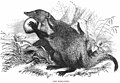 Mongoose, or Mangouste as depicted in the 1851 Illustrated London Reading Book
-
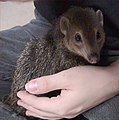 Common kusimanse, Crossarchus obscurus
-
 Angolan slender mongoose (Galerella flavescens)
-
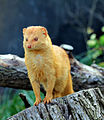 Slender mongoose (Galerella sanguinea)
-
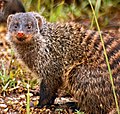 Banded mongoose, Mungos mungo
-
 Meller's mongoose, Rhynchogale melleri
-
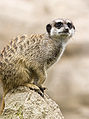 Meerkat, Suricata suricatta
-
 Banded mongoose
-
 Stripe-necked mongoose, Herpestes vitticollis
-
 Small Asian mongoose, Herpestes javanicus
-
 Indian gray mongoose, Herpestes edwardsii
-
 Indian gray mongoose pups
-
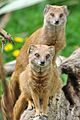 Yellow mongoose, Cynictis penicillata
-
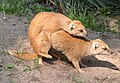 Cynictis penicillata mating
-
 Yellow mongoose
-
 Indian brown mongoose, Herpestes fuscus


No comments:
Post a Comment