Mandrill
From Wikipedia, the free encyclopedia
This article is about the primate. For other uses, see Mandrill (disambiguation).
| Mandrill[1] Temporal range: 1.2–0 Ma Early Pleistocene – Recent |
|
|---|---|
 |
|
| Male | |
 |
|
| Female | |
| Conservation status | |
| Scientific classification | |
| Kingdom: | Animalia |
| Phylum: | Chordata |
| Class: | Mammalia |
| Order: | Primates |
| Family: | Cercopithecidae |
| Genus: | Mandrillus |
| Species: | M. sphinx |
| Binomial name | |
| Mandrillus sphinx (Linnaeus, 1758)[3] |
|
 |
|
| Mandrill range | |
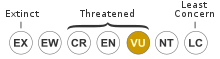
Both the mandrill and the drill were once classified as baboons in the genus Papio, but recent research has determined that they should be separated into their own genus, Mandrillus.[4] Mandrills are the world's largest monkeys. Charles Darwin wrote in The Descent of Man that "no other member in the whole class of mammals is coloured in so extraordinary a manner as the adult male mandrills".[5] The mandrill is classified as vulnerable by IUCN.
Contents
Description

The male mandrill's exotic coloring
The mandrill has one of the greatest sexual dimorphisms among the primates.[9] Males typically weigh 19–37 kg (42–82 lb), with an average mass of 32.3 kg (71 lb). Females weigh roughly half as much as the male, at 10–15 kg (22–33 lb) and an average of 12.4 kg (27 lb).[10] Exceptionally large males can weigh up to 54 kg (119 lb).[11][12][13] The average male is 75–95 cm (30–37 in) long and the female is 55–66 cm (22–26 in), with the short tail adding another 5–10 cm (2–4 in).[14][15] The shoulder height while on all fours can range from 45–50 cm (18–20 in) in females and 55–65 cm (22–26 in) in males. The male Mandrill is the heaviest monkey in the world, although its total length is relatively short due to its vestigial tail and, due to its high sexual dimorphism, baboons such as the Chacma and Olive average around the same weight. Compared to the largest baboons, the mandrill is more ape-like in structure, with a muscular and compact build, shorter, thicker limbs that are longer in the front and almost no tail.[16][17][18] Mandrills can survive up to 31 years in captivity. Females reach sexual maturity at about 3.5 years.

Mandrill skull (Muséum de Toulouse)
Ecology and activities

Close-up of a male mandrill's colorful face
The mandrill is an omnivore. It usually consumes plants, of which it eats over a hundred species. It prefers to eat fruits, but will also eat leaves, lianas, bark, stems, and fibers. It also consumes mushrooms and soil.[20] Carnivorously, mandrills mostly eat invertebrates, particularly ants, beetles, termites, crickets, spiders, snails, and scorpions. It will also eat eggs, and even vertebrates such as birds, tortoises, frogs, porcupines, rats, and shrews.[20] Mandrills likely will eat larger vertebrates when they have the opportunity, such as juvenile bay duikers and other small antelope. Large prey are likely killed with a bite to the nape with the mandrill's long canines.[23] In males, the canines can measure over 6 cm (2.4 in) in length.[16] One study found the mandrill's diet was composed of fruit (50.7%), seeds (26.0%), leaves (8.2%), pith (6.8%), flowers (2.7%), and animal foods (4.1%), with other foods making up the remaining (1.4%).[24]
Mandrills are preyed on mainly by leopards, in addition to crowned eagles and African Rock Pythons.[21] They may be bitten and killed by Gaboon vipers when they accidentally rouse the venomous snake. It is thought that most predators are a threat mainly to young mandrills, with the likelihood of predation decreasing in adult females and especially adult males. In a study where a mandrill troop was exposed to stimuli relating to their natural predators, only the leopard caused the larger part of the group to flee into trees. However, the large, dominant males were observed to remain in response to the images of the natural predators, even the leopard, and pace back and forth whilst baring their teeth, generally indicating aggression and the defensive role they may play in such circumstances.[25]
Mandrills are mostly terrestrial but they are more arboreal than baboons and feed as high as the canopy.[6][8] When on the ground, mandrills walk by digitigrade quadrupedalism (walking on the toes of all four limbs). When in the trees, they often move by lateral jumps.[19] Mandrills are mostly diurnal, with activities extending from morning to evening.[26] They sleep in trees at a different site each night.[20] Mandrills have been observed using tools; In the wild and in captivity, mandrills have been observed using sticks to clean themselves.[27]
Social behavior and reproduction
Mandrills seem to live in large, stable groups called "hordes". Hordes often number in the hundreds, possibly averaging around 620 individuals and reaching as many as 845.[19][21][22] It is difficult to accurately estimate group size in the forest, but filming a group crossing a gap between two forest patches or crossing a road is a reliable way of estimating group size. The largest group verifiably observed in this way contained over 1,300 individuals, in Lopé National Park, Gabon—the largest aggregation of nonhuman primates ever recorded.[28] These groups are made of adult females and their dependent offspring.[29] Males live a solitary lifestyle, and only enter hordes when females are receptive to mating, which lasts three months each year.[21][29] All-male bachelor groups are not known to exist.[21][29]
Sleeping mother with young
Mandrill births occur from January to May.[35] Most births in Gabon occur in the wet season, from January to March, and gestation usually lasts 175 days.[34] In captivity, 405 days separate each birth.[34] Young are born with a black natal coat and pink skin. The females do most of the raising of the young. Alloparenting exists in this species, with female relatives providing care for the young.[36] Males leave their natal groups when they are six years old and stay along the boundary of the social group.[21][29]
Mandrills will make a "silent, bared-teeth face", in which the teeth are bared, the head crest is erect and the head shakes. This may serve as a peaceful form of communication.[37][38] A mandrill submits by presenting its rump. With aggression, mandrills will stare, bob their heads, and slap the ground.[38] Vocalizations like roars, crowings, and "two-phase grunts" are made for long distances, while "yaks", grunts, "k-alarms", "k-sounds", screams, girneys, and grinds are made at short distances.[39]


No comments:
Post a Comment